Built for wholesale rubber export.
Indonesia Rubber is the export brand of PT FoodHub Collective Indonesia, headquartered in Jakarta Selatan, connecting Sumatra and Java mills with tire, industrial, and dipped-goods buyers who need tested lots and reliable documentation.
- 2018Founded
- 60+Mill and estate partners
- 13Export destinations
- 24,000tShipped per year
From Jakarta desk to global tire lines.
PT FoodHub Collective Indonesia registered in 2018 with a focus on Indonesian natural rubber export rather than domestic spot trading. Budi Santoso and the trading team built mill relationships across the Sumatra belt, Kalimantan estates, and Java compounding hubs so buyers could source TSR, RSS, and latex through one export desk.
Today we test every TSR lot to SNI 1903 before stuffing, visually grade RSS to Green Book standards, and confirm latex DRC and MST on every flexitank and drum shipment. Contract supply programmes run alongside spot containers for tire makers who need predictable monthly call-offs.
Our Jakarta office handles sales, contracts, and documentation. Partner mills in Sumatra and Java handle production and initial QC. Loading moves through Jakarta and Belawan to reach buyers in the United States, Japan, China, India, South Korea, and across Europe.
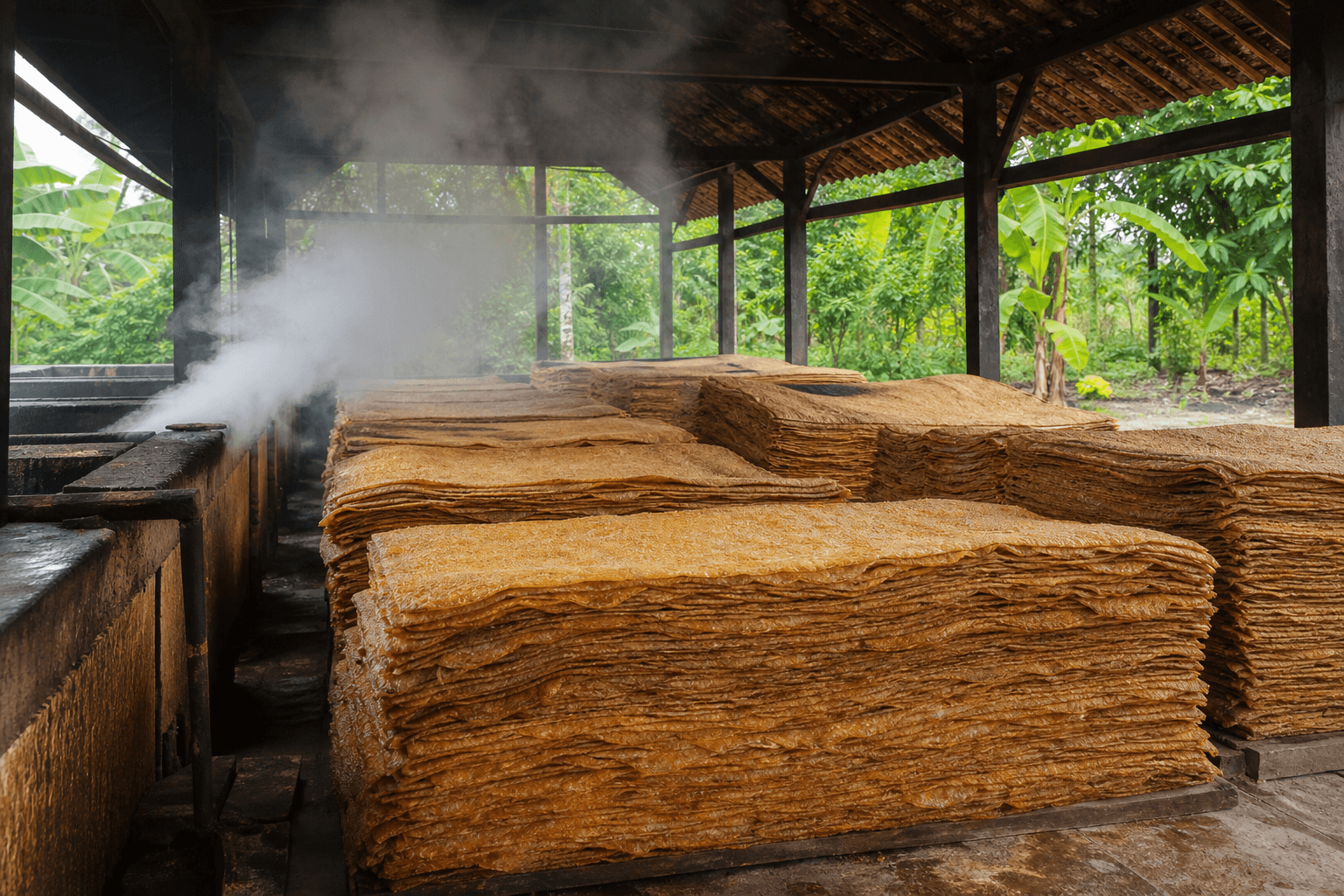
Jakarta trading desk, Indonesia Rubber
Eight years of export growth.
- 2018
Founded in Jakarta
PT FoodHub Collective Indonesia registered; first SIR 20 TSR containers shipped FOB Belawan to Asian tire plants.
- 2020
Expanded grade range
Added SIR 10 premium TSR, RSS smoked sheets, and HA latex concentrate to serve tire, industrial, and dipped-goods buyers from one catalogue.
- 2023
Centralised SNI testing
Laboratory confirmation of dirt, PRI, and Mooney standardised on every TSR export lot with retained samples in Jakarta.
- Today
13 export destinations
Around 24,000 tonnes of natural rubber a year reach tire, industrial, and dipped-goods buyers across Asia, Europe, and North America.
The standards behind every container.
Four commitments we make to every buyer, whether it is your first trial container or your twentieth contract quarter.
- Certified
- SNI 1903
- ISO 9001
- ISO 14001
- ISO 45001
- Halal (BPJPH)
- Green Book (RSS)
Answers for first-time buyers.
Minimum orders, samples, testing, and payment terms for Indonesian natural rubber importers.
How does Indonesia Rubber source natural rubber from Indonesian mills?
We buy from named partner mills across the Sumatra belt, Kalimantan, and Java compounding hubs under season-linked agreements, not from anonymous spot aggregators. Purchase contracts reference the mill and grade so buyers know which production line supplied each container. Our Jakarta desk coordinates testing, documentation, and vessel booking for every export lot.
What traceability records ship with each natural rubber export lot?
TSR shipments include SNI 1903 test summaries, commercial invoice, packing list, certificate of origin, weight and quality certificates, and loading photos. RSS lots add Green Book grading records. Latex shipments include drum or flexitank serial numbers tied to the laboratory COA. Retained samples are held in Jakarta against the contract reference.
What testing is completed at the Jakarta desk before TSR export?
Bales are sampled for dirt content, ash, volatile matter, nitrogen, PRI, and Mooney viscosity ML (1+4) at 100 °C against SNI 1903 grade tables. Out-of-spec bales are segregated before stuffing. Results are issued on the pre-shipment report that matches the commercial invoice lot reference.
How long has Indonesia Rubber been exporting natural rubber internationally?
PT FoodHub Collective Indonesia registered and shipped its first SIR 20 TSR containers in 2018. Today we move around 24,000 tonnes a year to buyers in 13 primary markets across Asia, Europe, and North America. Jakarta handles sales and contracts; Belawan and Jakarta ports handle container loading.
Tell us your grade mix and destination port.
Share volume, incoterms, and whether you need TSR, RSS, or latex. We reply with availability, COA parameters, and an indicative quote within one business day.