Indonesian RSS Sheet Export Documents Checklist
Use this Indonesian RSS sheet export documentation checklist to issue cleaner POs and prevent customs or freight delays before shipment.
By Budi SantosoDirector of Rubber TradingTwelve years placing Indonesian TSR and RSS programmes with tire makers and industrial compounders across Asia, Europe, and North America.

Indonesian RSS sheet buying is not finished when the grade and price are agreed. The shipment still has to pass your import file, your freight forwarder’s booking checks, your customs broker’s HS code review, and your plant’s receiving inspection.
We supply Indonesian RSS 1 and RSS 3 as export sheet rubber, so we ask buyers to make the purchase order specific before production and booking. The points below are the checks we would put into a buyer’s PO and pre-shipment document request for Indonesian RSS sheet export documentation.
What documents are required to import RSS sheet from Indonesia?
A normal import file for Indonesian RSS sheet should include the commercial invoice, packing list, bill of lading, certificate of analysis, certificate of origin, and any destination-specific quarantine or wood-packaging documents. Your customs broker should confirm the final list before shipment because import rules are set by the destination country.
For RSS sheet, the grade document and the shipping documents must say the same thing. If the invoice says RSS 3 but the COA says “smoked sheet” with no grade, your customs broker or factory QA team may ask for clarification after the container has already sailed. We recommend requiring the same grade name across the PO, invoice, packing list, COA, and draft bill of lading.
The certificate of origin depends on your import route. Buyers commonly ask for either a non-preferential Certificate of Origin or a preferential certificate where their country accepts a trade-agreement form. In Indonesia, Certificates of Origin are issued through the e-SKA system administered by the Ministry of Trade. If your broker needs a specific form, state the form name in the PO rather than asking for a generic COO.
For customs classification, our RSS 1 and RSS 3 sheet rubber use HS code 4001.21. Ask your broker to confirm the import tariff line and any local statistical suffix before the commercial invoice is finalized. The six-digit HS code is the same starting point, but many countries add national digits.
If your team is still qualifying the product grade, start with our RSS smoked sheet rubber overview before requesting the document pack.
What should the PO say about RSS grade, MOQ, price, and Incoterm?
The PO should name the RSS grade, quantity, packing format, Incoterm, shipment port, HS code, document set, and any special import certificates. This is where buyers prevent most avoidable documentation disputes.
For our RSS 3 Smoked Sheet Tire Grade, the specification is dirt content ≤ 0.20% w/w, ash content ≤ 1.00% w/w, volatile matter ≤ 0.80% w/w, nitrogen ≤ 0.60% w/w, PRI ≥ 50, sheet grade RSS 3 under Green Book, minimum order 19.6 MT equal to 1 × 20 ft FCL, packing as 33.33 kg sheets in wooden crates or palletised bundles, lead time 2–3 weeks FOB Belawan or Palembang, certifications listed as Green Book (RSS), ISO 9001, ISO 14001, and Halal from BPJPH, Incoterms FOB, CIF, and CFR, and HS code 4001.21.
For our RSS 1 Premium Smoked Sheet, the specification is dirt content ≤ 0.05% w/w, ash content ≤ 0.50% w/w, volatile matter ≤ 0.80% w/w, nitrogen ≤ 0.60% w/w, PRI ≥ 60, sheet grade RSS 1 under Green Book, minimum order 19.6 MT equal to 1 × 20 ft FCL, packing as 33.33 kg sheets in wooden crates, lead time 3–4 weeks for limited seasonal volume, certifications listed as Green Book (RSS), ISO 9001, ISO 14001, and Halal from BPJPH, Incoterms FOB, CIF, and CFR, and HS code 4001.21.
Price should not be requested as a loose “best price.” Ask for the grade, packing, Incoterm, shipment month, volume, and price validity. RSS offers may be compared against SGX SICOM RSS3 futures published by Singapore Exchange, with an origin differential and logistics cost added according to the transaction. We do not quote a spot price in this article because it will go stale.
Under Incoterms 2020 published by the International Chamber of Commerce, FOB places the seller’s delivery obligation at loading on board the vessel at the named port. CFR adds freight to the destination port, while CIF adds freight plus insurance. If your company controls freight contracts, request FOB. If you need a landed planning figure before opening an internal purchase approval, request CFR or CIF and ask what freight assumptions are included.
For a current RSS 3 quotation matched to your destination port and document requirements, send your PO draft through our contact page.
Can RSS sheets be shipped in a 20 ft FCL?
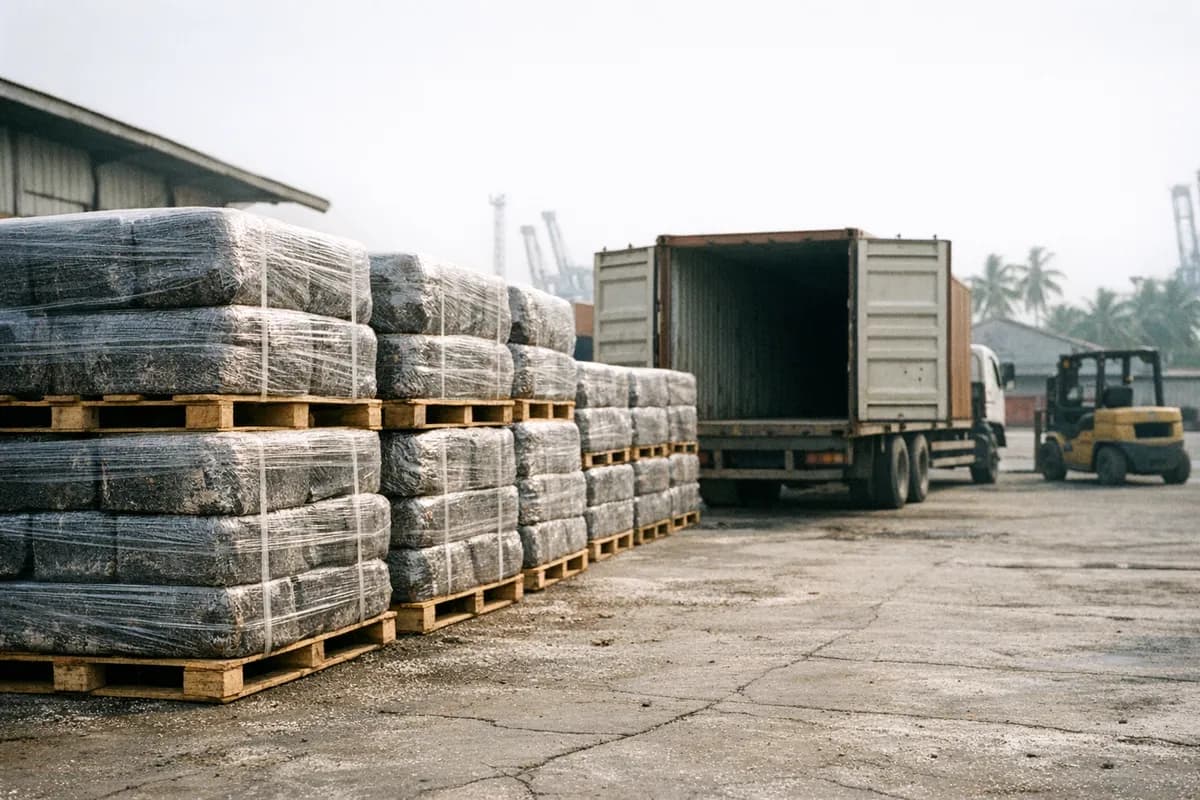
Yes. Our RSS 3 and RSS 1 minimum order is 19.6 MT, equal to 1 × 20 ft FCL. A full-container shipment is the normal export unit because it reduces mixed-cargo handling and gives the buyer one container, one seal, and one packing list to reconcile.
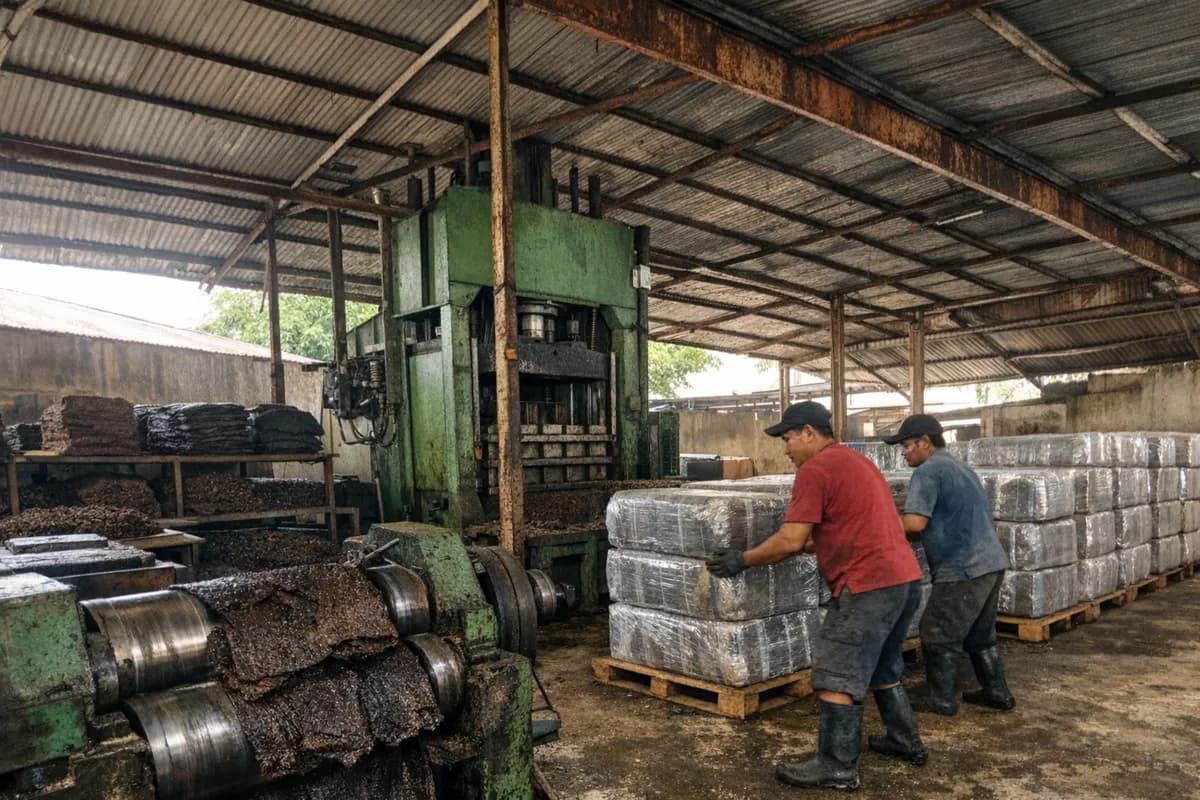
The packing choice should be settled before the container is booked. For RSS 3, we offer wooden crates or palletised bundles. For RSS 1, we offer wooden crates. Crates give physical protection and a clear unit load for sheet rubber. Palletised bundles can suit buyers whose warehouse is set up for forklift unloading and rapid staging, but the PO should state bundle handling needs clearly.
Container stowage should be written as an operational instruction, not left to “standard export packing.” Ask for a clean, dry, odor-free container with no visible holes, oil stains, chemical residue, or wet flooring. If your route has a high condensation risk, state whether your forwarder requires kraft lining, desiccants, or other moisture-control measures. Those items affect loading instructions and should be priced or approved before booking.
Your receiving team should also know what to check against the packing list. The container number and seal number should match the bill of lading. The unit count and net weight should reconcile with the invoice. Any torn crate, loose sheet bundle, water mark, or odor should be photographed before unloading continues.
Buyers comparing sheet grades for different factories can review our smoked sheet export collection before deciding between RSS 1 and RSS 3.
Do RSS sheets need a phytosanitary certificate or fumigation?
RSS sheet itself is a processed natural rubber product, but phytosanitary and fumigation requirements can still appear because of the destination country or the wood packaging. Put the requirement in the PO if your customs broker, quarantine authority, or letter of credit requires it.
The most common issue is not the rubber sheet, but the wooden crate or pallet. ISPM 15, published by the International Plant Protection Convention, requires regulated wood packaging material used in international trade to be debarked and treated, including heat treatment to a minimum wood-core temperature of 56 °C for 30 minutes. If your country enforces ISPM 15 for crates or pallets, require compliant marks or treatment evidence in the shipping file.
Do not use “fumigation certificate” as a vague phrase. State whether you need a fumigation certificate for the cargo, a wood-packaging treatment certificate, an ISPM 15 mark on wood packaging, or a phytosanitary certificate issued for import clearance. These are different documents, and a late change can hold the container after loading.
If your bank is checking documents under a letter of credit, copy the exact certificate wording into the PO and proforma invoice stage. Banks examine document text. They do not repair unclear operational requests after shipment.
How long is typical FOB lead time for Indonesian RSS 3?
Our typical lead time for RSS 3 is 2–3 weeks FOB Belawan or Palembang. Count that timing from the point where grade, quantity, packing, Incoterm, payment conditions, and document requirements are agreed.
Belawan and Palembang are both practical origin options for Indonesian RSS 3, but the right port depends on allocation, sailing schedule, freight routing, and your required arrival date. FOB week is not the same as ETA at your destination. If your factory needs rubber for a production window, give us the latest acceptable arrival date as well as the requested FOB period.
RSS 1 needs more planning because our lead time is 3–4 weeks for limited seasonal volume. If your tender allows RSS 1 or RSS 3 alternatives, specify which grade must be quoted as firm and which can be offered as an option. That avoids a PO revision after lab or procurement approval.
A practical FOB schedule has four checkpoints. First, confirm the grade and packing. Second, finalize the proforma invoice, Incoterm, port, and payment terms. Third, prepare the COA, packing plan, COO instruction, and any quarantine or wood-packaging documents. Fourth, book the vessel, load the container, issue the draft bill of lading, then release final documents after the bill details are checked.
If you need RSS 3 from Belawan or Palembang for a fixed production month, send the destination port, preferred Incoterm, and document checklist through our contact page.
How should importers check the COA and draft paperwork before shipment?
Check the COA first against the PO specification, then check the shipping documents against the COA. The grade name, HS code, quantity, packing format, invoice number, container number, and shipment port should not conflict across the file.
For RSS 3, the COA should report the agreed RSS 3 grade and the tested values your factory needs for intake approval. For RSS 1, pay close attention to the lower dirt and ash limits because that is one reason buyers select the grade. Do not accept a COA that is only a generic product brochure. It should connect to the shipment or lot offered.

Before shipment, ask for draft copies of the commercial invoice, packing list, COO instruction, COA, and bill of lading details. The draft bill of lading should show the shipper, consignee or order party, notify party, port of loading, port of discharge, cargo description, gross weight, net weight where applicable, container number, and seal number once loaded. If your bank or broker requires exact wording, provide it before the draft is issued.
The final check is reconciliation. The PO should point to one grade, one Incoterm, one packing method, one HS code, and one document set. When those items match before the container sails, customs clearance and factory receiving become a document check rather than a dispute. For product options beyond RSS sheet, our products page shows the wider Indonesian natural rubber export range.