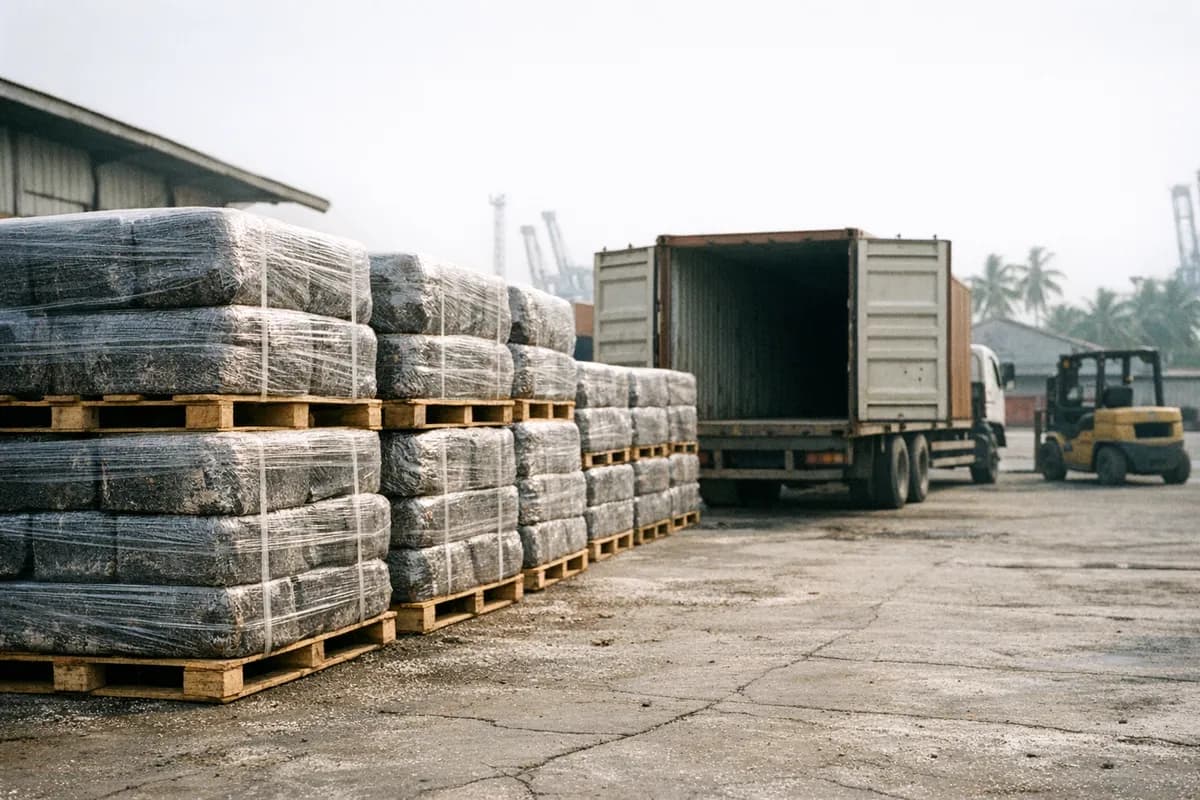
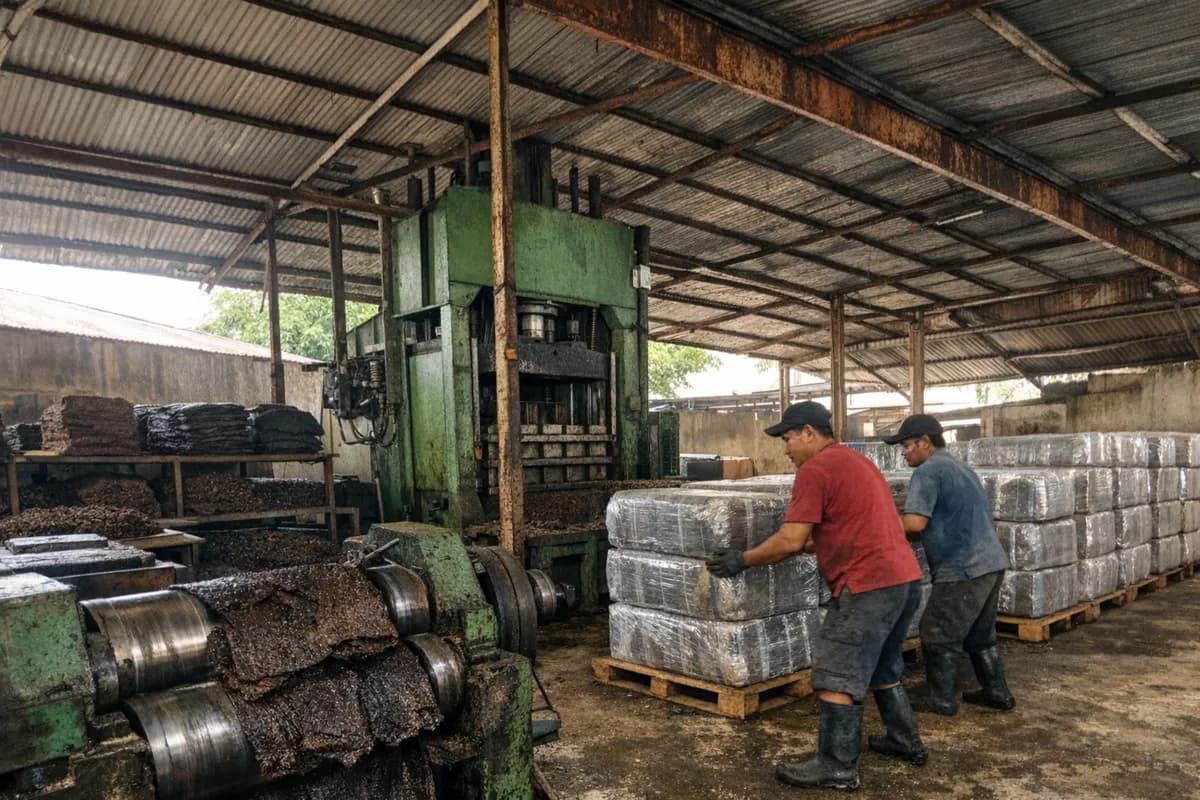
How Indonesian RSS Sheet Is Dried and Graded: RSS 1 vs RSS 3
Learn how RSS 3 graded Indonesia supply is smoked, visually sorted, and checked with lab metrics before you approve shipment.
By Budi SantosoDirector of Rubber TradingTwelve years placing Indonesian TSR and RSS programmes with tire makers and industrial compounders across Asia, Europe, and North America.
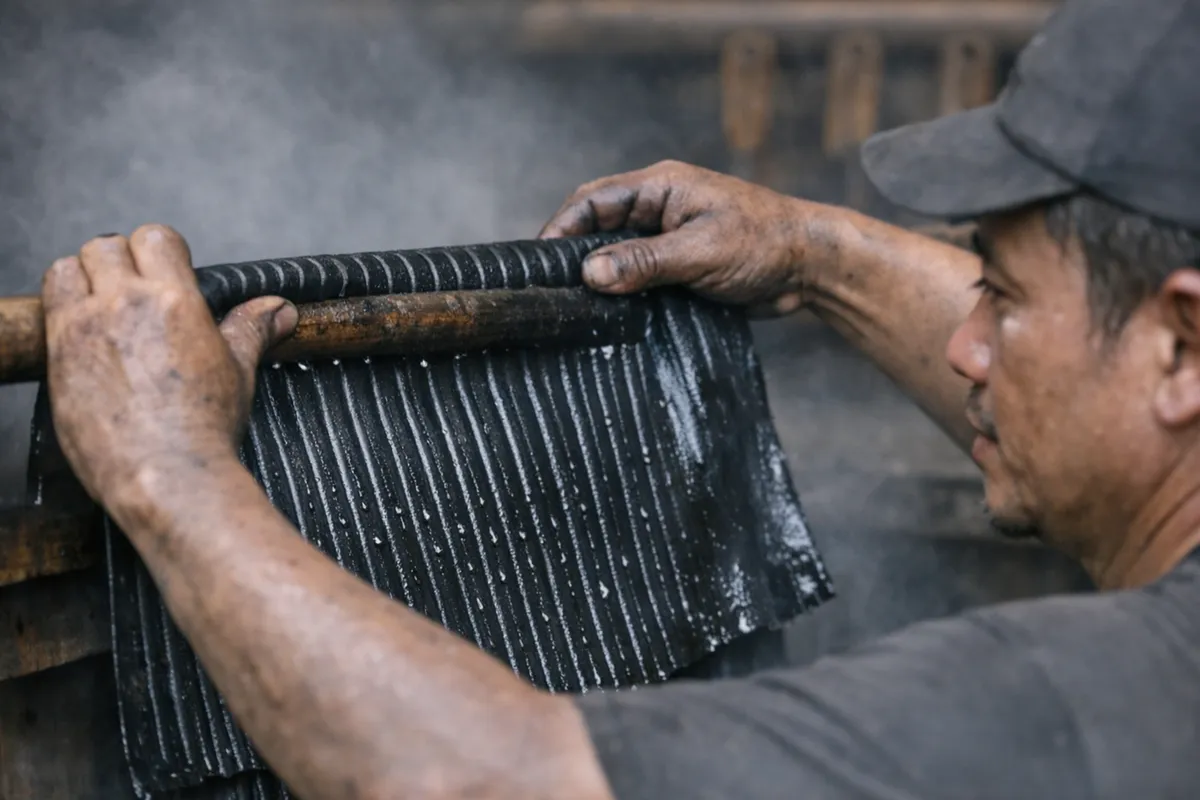
RSS 3 is not graded by appearance alone. The sheet must first be made correctly, dried without trapping moisture, smoked without burning the rubber, then sorted against visual grade expectations and supported by lab values.
We supply Indonesian RSS sheet for export buyers who need Green Book grade language tied to practical acceptance checks. This article explains how Indonesian RSS 3 is produced, how buyers should read RSS 1 versus RSS 3, and what to verify before a container is accepted for shipment.
How is RSS 3 smoked sheet produced in Indonesia?
Indonesian RSS 3 is produced by coagulating natural rubber latex into thin sheets, rolling the sheets through ribbed rollers, drying them, and smoking them until the sheet is stable enough for grading and packing. The grade result depends on latex cleanliness, sheet thickness control, smokehouse discipline, and final sorting.
The process starts before the smokehouse. Field latex must be strained so bark, sand, coagulum fragments, and other visible matter do not enter the sheet. Coagulation then turns the latex into a slab that can be rolled. Ribbed rollers increase surface area, help water escape, and leave the pattern that buyers expect in ribbed smoked sheet.
After rolling, the sheets are washed and hung for initial dripping. This step matters because surface water carried into the smokehouse can create uneven drying. Wet pockets become visible later as cloudy, tacky, or mould-prone areas. A sheet that looks acceptable on the outer surface can still fail handling if moisture remains inside thicker areas.

Smoking is both drying and preservation. The smokehouse must remove moisture while avoiding scorching, soot build-up, or hard, brittle edges. In practical inspection terms, buyers should look for sheets that are dry to the touch, free from wet centres, free from heavy soot, and not stuck together in blocks. If you are qualifying a new supplier, ask for the smoking and drying control points they record by lot, not only a finished cargo photograph.
For a current product view, our RSS 3 Smoked Sheet Tire Grade page sets out the export grade we offer for tire and general rubber goods buyers.
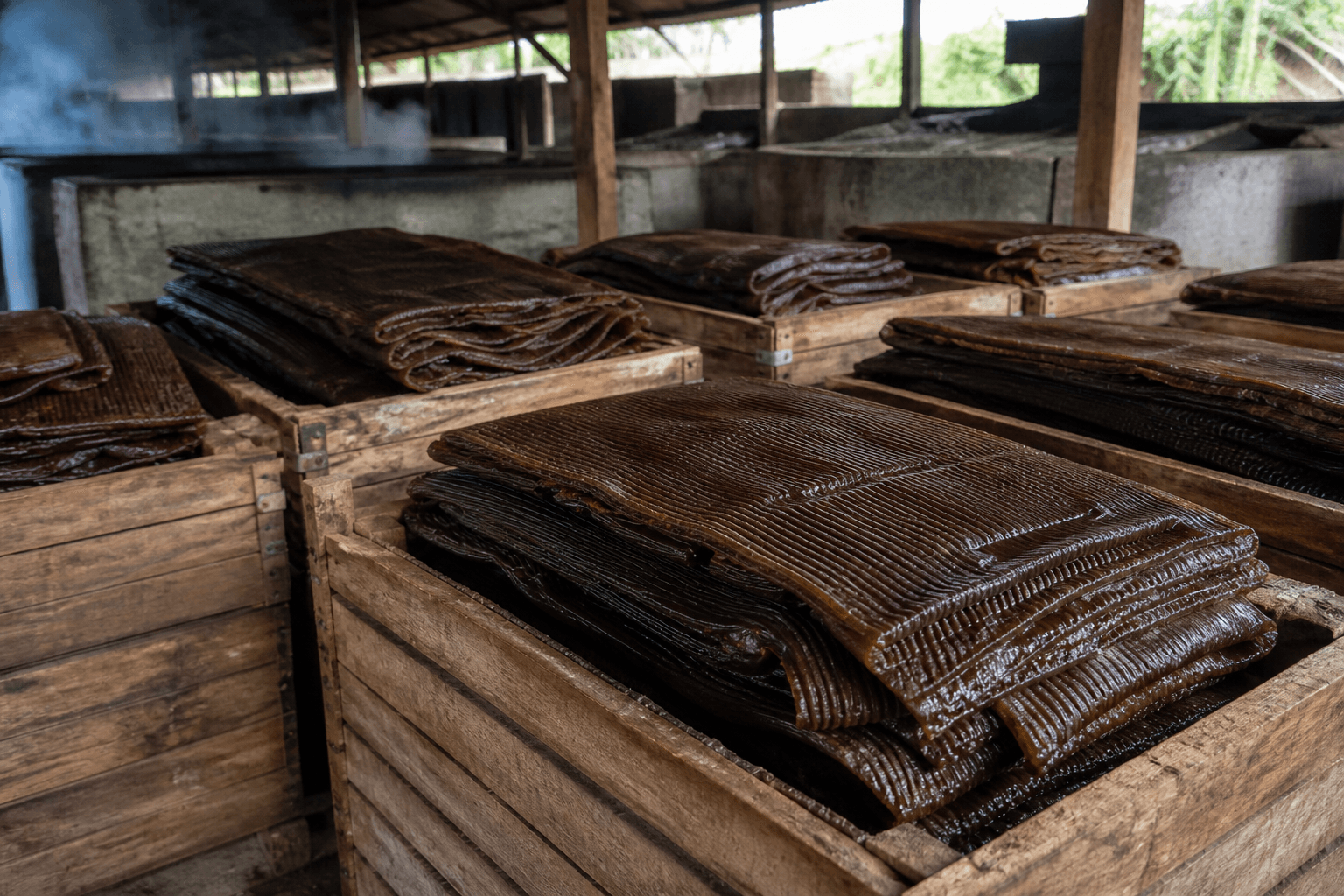
Featured product
RSS 3 Smoked Sheet Tire Grade
Green Book RSS 3 sheets with dirt at or below 0.20%, PRI at or above 50, for tire tread compounds.
Green Book (RSS) · ISO 9001 · ISO 14001 · Halal (BPJPH)
View specificationsHow is Indonesian RSS 3 graded against RSS 1?
RSS 3 and RSS 1 are both Green Book smoked sheet grades, but RSS 1 is the tighter selection and needs cleaner sheet appearance and lower contamination limits. RSS 3 is the more common tire-grade smoked sheet where buyers still require controlled dirt, ash, volatile matter, nitrogen, and PRI.
For our RSS 3 Smoked Sheet Tire Grade, the specification is: dirt content ≤ 0.20% w/w, ash content ≤ 1.00% w/w, volatile matter ≤ 0.80% w/w, nitrogen ≤ 0.60% w/w, PRI ≥ 50, sheet grade RSS 3 (Green Book), minimum order 19.6 MT or 1 × 20 ft FCL, packing in 33.33 kg sheets with wooden crates or palletised bundles, lead time 2–3 weeks FOB Belawan or Palembang, certifications Green Book (RSS), ISO 9001, ISO 14001, and Halal from BPJPH, Incoterms FOB, CIF, and CFR, and HS code 4001.21.
For our RSS 1 Premium Smoked Sheet, the specification is: dirt content ≤ 0.05% w/w, ash content ≤ 0.50% w/w, volatile matter ≤ 0.80% w/w, nitrogen ≤ 0.60% w/w, PRI ≥ 60, sheet grade RSS 1 (Green Book), minimum order 19.6 MT or 1 × 20 ft FCL, packing in 33.33 kg sheets with wooden crates, lead time 3–4 weeks with limited seasonal volume, certifications Green Book (RSS), ISO 9001, ISO 14001, and Halal from BPJPH, Incoterms FOB, CIF, and CFR, and HS code 4001.21.
The commercial lesson is simple: do not buy “RSS sheet” without naming the grade and the acceptance values. RSS 1 is not just a cleaner label. It has tighter limits for dirt, ash, and PRI in our offer, so availability depends on the ability to select cleaner sheets from production. When weather or latex quality reduces the volume of clean, evenly dried sheet, RSS 1 can be seasonally limited.
If your plant needs the tighter grade for industrial or specialty compounds, compare our RSS 1 Premium Smoked Sheet with the RSS 1 grade page before issuing the purchase specification.
What do dirt, ash, volatile matter, PRI, and nitrogen tell buyers?
These five values turn a visual sheet grade into a checkable technical file. They do not replace visual grading, but they help the buyer understand contamination, drying quality, ageing resistance, and protein-related composition.
Dirt content is the first contamination signal. In smoked sheet, dirt can come from poor latex straining, dirty coagulation trays, contaminated rolling areas, dirty hanging racks, or careless packing. The International Organization for Standardization publishes ISO 249 for determination of dirt content in raw natural rubber. In buying terms, dirt is the value most directly connected to visible foreign matter and downstream filtration complaints.
Ash content measures inorganic residue after the rubber is burned under a controlled lab method. The International Organization for Standardization publishes ISO 247 for ash determination in raw rubber. High ash can point to mineral contamination from soil, water, processing aids, or handling surfaces. A buyer may see clean-looking sheets yet still receive an ash result that shows inorganic residue beyond the agreed limit.
Volatile matter is a drying and storage indicator. The International Organization for Standardization publishes ISO 248-1 for volatile-matter determination in raw rubber. For smoked sheet buyers, volatile matter is where drying discipline shows up. A lot with high volatile matter can be tacky, more prone to mould, and harder to store safely in humid conditions.
PRI, or plasticity retention index, indicates resistance to oxidative ageing after heat exposure. The International Organization for Standardization publishes ISO 2930 for determination of PRI in raw natural rubber. A higher PRI is useful where a compounder needs rubber that keeps more of its plasticity after thermal ageing. For our offer, RSS 1 carries the higher PRI requirement, while RSS 3 is set for tire-grade use.
Nitrogen is a proxy linked to natural non-rubber constituents, including protein material. The International Organization for Standardization publishes ISO 1656 for nitrogen determination in raw natural rubber and latex. Buyers should treat nitrogen as a composition check, not as a visual grading tool.
If your procurement team wants a quotation that includes the lab values your QA team will review, send your destination port, grade, and expected monthly volume through our contact page.
What defects should buyers check before accepting RSS sheets?
Buyers should check RSS sheets for wet areas, mould, bubbles, scorched zones, heavy soot, dirt, bark, sand, oil stains, uneven thickness, stuck sheets, and packaging damage. These defects point back to coagulation, rolling, drying, smoking, storage, or container handling.
Start with the top, sides, and inner layers of crates or bundles. Do not inspect only the outer face. Ask the loading team to open enough units so the inspector can see sheets from different positions in the lot. A clean top layer does not prove the inner sheets are dry.
Visual signs to record include:
- Cloudy patches or pale wet centres, which suggest incomplete drying.
- Black specks, bark, sand, and hard particles, which point to latex or floor contamination.
- Mould growth or musty odour, which points to moisture and storage problems.
- Very dark, brittle, or burnt sections, which suggest excessive smokehouse heat or poor smoke control.
- Sheets stuck together, which may indicate tackiness, pressure, moisture, or warm storage.
- Oil marks, chemical odours, or grease, which are handling defects rather than natural rubber features.
- Torn crates, broken strapping, wet pallets, or water marks inside the container.
Photographs should show the defect, the crate or bundle mark, and the container or warehouse context. For a claim or rejection discussion, a close-up image without lot identification is weak evidence. Keep a retained sample from the same lot and mark the sampling date, grade, supplier, container number, and inspector name.
Storage after production can also damage otherwise acceptable sheet. Keep RSS away from rain, standing water, oil, strong odours, direct sun, and hot container walls. Condensation inside a container can create local wetting even when the lot left the warehouse dry. At receiving, inspect the container ceiling, door gaskets, floor, and side walls before unloading.
Which on-site tests can verify an RSS 1 grade at loading?
On-site checks can screen whether RSS 1 is plausible, but they cannot fully prove RSS 1 without lab testing against the agreed values. Use site inspection to reject obvious defects, then use sampling and lab results to confirm dirt, ash, volatile matter, PRI, and nitrogen.
At loading, the inspector can verify grade marking, packing format, crate or bundle condition, sheet appearance, odour, dryness by touch, and visible contamination. A moisture meter may help as a screening tool if your QA procedure allows it, but the acceptance value should still be tied to the lab volatile-matter result when that is part of the contract.
Sampling should be spread across the lot. Do not allow samples to be taken from only the easiest crate or the cleanest bundle. A practical instruction is to draw sheets from multiple positions, including top, middle, and inner sections where access is possible, then seal the composite or retained samples under the buyer’s inspection procedure. If a third-party inspector is used, the sampling procedure should be written into the booking instruction before the inspector arrives.
For RSS 1, visual selection matters more because the grade is tighter. The inspector should look for uniform drying, clean surface, absence of mould, and low visible dirt. Still, the final grade acceptance should not rest on photographs alone. Put the lab methods or equivalent accredited methods into the purchase order so the seller, buyer, and inspector are using the same yardstick.
Buyers who are comparing RSS sheet options by grade can also review our RSS 3 grade page and the broader smoked sheet export collection.
What acceptance criteria should go into the PO for Indonesian RSS sheet?
The PO should name the exact RSS grade, lab limits, packing, Incoterm, shipment port, sampling requirement, inspection point, and rejection process. A clean PO reduces arguments because the supplier, inspector, lab, and buyer all work from the same acceptance file.
For grade language, write “RSS 3 (Green Book)” or “RSS 1 (Green Book)” and match the lab values to the grade you are buying. Do not use mixed wording such as “RSS 1 or RSS 3 equivalent” unless your technical team has approved either grade for the same compound. If the plant requires RSS 1 performance, buying RSS 3 because it is available sooner may create production issues later.
For inspection, state whether acceptance is based on pre-shipment inspection, arrival inspection, or both. Include the sampling point, who may draw samples, how samples are sealed, and which lab methods apply. If defects are found, state whether the buyer can reject the affected crates, require replacement, claim an allowance, or hold the shipment pending lab confirmation.
For documents, connect the commercial file to the cargo file: grade, net weight, packing, origin, Incoterm, shipment port, container number, and certificate details should not conflict. We cover document flow separately in our Indonesian RSS sheet export documentation checklist; this grading file should sit beside it, not replace it.
A good RSS purchase order is specific enough that an inspector can use it at the warehouse without asking what the buyer meant. That is the point of grading: the sheet, the lab report, and the shipping file should all describe the same rubber.